

Retirement income does not always stretch as far as people expect. Groceries cost more, medical bills keep coming, and even a small increase in rent or electricity can put pressure on a fixed monthly budget. Yet many older Americans may qualify for government assistance they have never applied for.
Some programs help pay Medicare premiums, while others provide grocery benefits, housing assistance, or support with household bills. A few are designed specifically for people over 60 or 65, and others depend mainly on income.
The important part is knowing where to look. These 15 federal, state, and local benefits are worth checking in 2026, even if you already receive Social Security.
First, Understand Why These Benefits Are Easy to Miss
Government assistance is not one single program. Medicare, Social Security, Medicaid, and state agencies all have different rules, application processes, and income limits.
Receiving Social Security does not automatically enroll someone in every other benefit. Some programs require a separate application, while others depend on household size, medical expenses, disability status, or where a person lives.
The good news is that qualifying for one program may also make it easier to receive another. Here is a quick look at where help may be available.
| Expense | Government Assistance Worth Checking |
|---|---|
| Medicare premiums | Medicare Savings Programs |
| Prescription medications | Extra Help |
| Limited retirement income | Supplemental Security Income |
| Groceries | SNAP and senior food programs |
| Heating and cooling | LIHEAP |
| Home energy improvements | Weatherization Assistance |
| Rent | Housing Choice Vouchers |
| Phone or internet | Lifeline |
These programs do not all provide monthly cash payments. Some lower an existing bill, while others provide food, medical coverage, or services that would otherwise cost money.
Eligibility is never guaranteed simply because someone reaches retirement age. Still, checking a program can be worthwhile before assuming that retirement income is too high to qualify.
1. Medicare Savings Programs Can Pay Costs You May Be Covering Yourself

Many retirees know that Medicare is not completely free. What they may not realize is that state-run Medicare Savings Programs can help qualifying people pay Medicare expenses.
In 2026, the standard Medicare Part B premium is $202.90 per month. For someone receiving $1,800 in monthly Social Security benefits, that premium alone takes a noticeable share of their income.
There are several Medicare Savings Programs, and each covers different expenses.
| Program | What It Can Help Pay | 2026 Individual Monthly Income Limit |
|---|---|---|
| Qualified Medicare Beneficiary (QMB) | Part A and B premiums and covered cost-sharing | $1,350 |
| Specified Low-Income Medicare Beneficiary (SLMB) | Part B premium | $1,616 |
| Qualifying Individual (QI) | Part B premium | $1,816 |
These are federal baseline income limits. Resource limits also apply, and some states allow people with higher income or assets to qualify.
Someone approved for QMB receives especially valuable protection. Medicare providers generally cannot charge QMB participants for Medicare-covered deductibles, coinsurance, or copayments.
An older adult who has never applied can contact the state Medicaid office and request a Medicare Savings Program eligibility review. Even someone who was previously turned down may qualify after changes in income, household circumstances, or state rules.
2. Extra Help Can Reduce Prescription Drug Costs
Prescription medicine can become one of retirement’s most frustrating expenses. A person may have Medicare Part D coverage and still struggle with premiums, deductibles, and pharmacy bills.
The federal Extra Help program, also called the Part D Low-Income Subsidy, reduces these costs for people with limited income and resources. Some qualify automatically, but others must apply.
For 2026, the standard income and resource limits are:
| Household | Annual Income Limit | Resource Limit |
|---|---|---|
| Individual | $23,940 | $18,090 |
| Married couple | $32,460 | $36,100 |
These are the published general limits. Certain income exclusions and special circumstances can affect eligibility, so someone slightly above a listed amount should still ask for a review.
Extra Help can reduce covered prescription costs and remove the Part D late enrollment penalty while a person receives the assistance. It may therefore be worth checking even for retirees who already have a drug plan.
Applications are available through the Social Security Administration. Older adults who find Medicare confusing can also request free guidance from their State Health Insurance Assistance Program, commonly called SHIP.
3. Supplemental Security Income May Add Money to a Small Retirement Check

Some older adults assume that Social Security retirement benefits are the only monthly payments available to them. However, Supplemental Security Income, commonly called SSI, is a separate federal program.
SSI provides financial assistance to qualifying people who are at least 65, blind, or disabled and have limited income and resources. Unlike regular Social Security retirement benefits, SSI is based on financial need rather than a person’s work history.
In 2026, the maximum federal SSI payment is $994 per month for an eligible individual and $1,491 for an eligible couple. These are maximum federal amounts, not payments that everyone receives.
Other income, living arrangements, and countable resources can reduce payments or affect eligibility. The general SSI resource limit is $2,000 for an individual and $3,000 for a couple, although certain property is excluded.
It is also possible for some people to receive both Social Security retirement benefits and a smaller SSI payment. That depends on how much countable income and resources they have.
An older adult receiving a relatively small retirement check can request an SSI eligibility screening through Social Security. The agency can explain whether retirement income, savings, and living arrangements meet the program’s requirements.
4. Medicaid May Cover Health Care and Long-Term Support Medicare Does Not

Medicare covers many medical services, but it does not generally pay for long-term personal care when that is the only care someone needs. This can become a serious financial problem when an older adult needs regular help with bathing, dressing, or moving around the house.
Medicaid may cover additional health services and long-term care for eligible older adults. Depending on the state and program, that can include nursing facility care or services provided at home and in the community.
The federal Home and Community-Based Services system allows qualifying Medicaid recipients to receive certain forms of support outside nursing facilities. The services and financial requirements vary significantly by state.
Some older adults assume that Medicare enrollment means they cannot also qualify for Medicaid. In reality, people who qualify for both programs are commonly called dual-eligible beneficiaries.
This combination can be especially important for retirees who have substantial medical needs but limited income. Medicaid may help cover certain expenses that would otherwise place pressure on household finances.
State Medicaid agencies can review eligibility for older adults and explain available long-term care services. Those needing help at home can also ask whether their state offers home-based services through a Medicaid waiver or another approved program.
5. SNAP Can Help Pay for Groceries Even When You Receive Social Security
Food costs can take a larger share of retirement income than expected. For someone living alone, buying fresh produce, meat, dairy products, and other household basics can quickly stretch a limited budget.
The Supplemental Nutrition Assistance Program, or SNAP, provides eligible households with money for approved groceries. Benefits generally arrive through an Electronic Benefit Transfer card that works at participating retailers.
SNAP has special rules for households with an older or disabled member. For SNAP purposes, age 60 is considered elderly, and certain qualifying out-of-pocket medical expenses above $35 per month can be deducted when calculating eligibility and benefits.
That detail matters because retirement income alone does not tell the whole financial story. A senior spending heavily on prescriptions, doctor visits, and other eligible medical costs may have a different benefit calculation from someone with the same income but fewer expenses.
SNAP rules also differ by state, and some states use broader eligibility rules. Receiving Social Security does not automatically rule someone out.
Applications are handled through state SNAP agencies. Older adults should report qualifying medical and housing expenses accurately and keep supporting bills because these costs may affect the amount of assistance available.
6. The Senior Food Box Program Provides Groceries to Eligible Adults Over 60
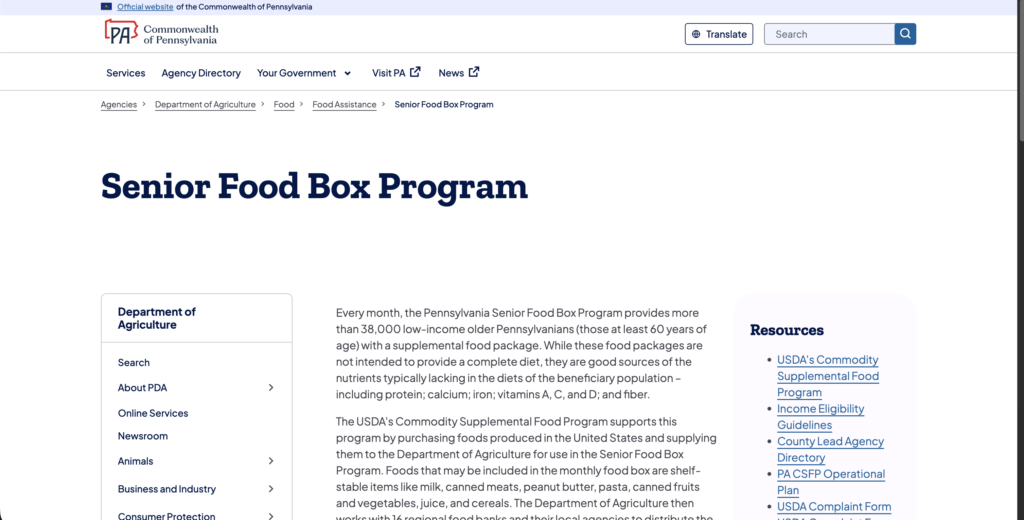
Not every food assistance program provides money through a benefits card. Some offer actual groceries that older adults can take home and use throughout the month.
The Commodity Supplemental Food Program, commonly called CSFP, is a USDA-funded program for qualifying low-income adults age 60 and older. It provides supplemental food packages through participating states and local organizations.
Packages may contain shelf-stable foods such as canned vegetables, fruit, grains, and protein foods. The purpose is to improve nutrition rather than replace someone’s entire grocery budget.
This program operates separately from SNAP. An older adult should ask about both programs rather than assuming that one automatically replaces the other.
Local availability matters because CSFP operates through participating agencies and has a limited number of available slots. Some areas may maintain waiting lists when demand exceeds available funding.
State CSFP agencies, local food banks, and Area Agencies on Aging can provide enrollment information. They can also explain whether food packages are distributed nearby and whether applications are currently being accepted.
7. Senior Farmers Market Benefits Can Help Pay for Fresh Produce

Fresh fruits and vegetables can be expensive, particularly when a grocery budget is already tight. A separate USDA program helps eligible older adults buy certain locally grown foods.
The Senior Farmers Market Nutrition Program provides benefits that can be used with participating farmers and approved markets. Depending on the state, these may be offered through coupons or electronic benefit systems.
The program generally serves adults age 60 and older whose household income meets the program’s limits. Benefits can help purchase approved fresh fruits, vegetables, herbs, and honey.
Unlike SNAP, this is often a seasonal benefit. Application periods, available funding, benefit values, and participating markets depend on the state.
That makes timing important. An older adult who checks only after the local application period closes may have to wait until the next program year.
State agriculture departments and local aging agencies can explain when enrollment opens. They can also identify participating markets and clarify which products are covered.
Compare the Three Main Food Assistance Options
| Program | Type of Help | Important Age Rule |
|---|---|---|
| SNAP | Monthly grocery assistance | Special elderly household rules at 60+ |
| CSFP | Supplemental food packages | Must be 60+ |
| Senior Farmers Market Program | Benefits for approved local produce | Generally 60+ |
All three have eligibility rules beyond age. Availability and the ability to receive multiple programs must be checked with the agencies administering them.
8. LIHEAP Can Help Pay Heating and Cooling Bills
Electricity, gas, and heating costs can put serious pressure on a fixed retirement income. This is especially difficult for older adults who need safe indoor temperatures during very hot or cold weather.
The Low Income Home Energy Assistance Program, known as LIHEAP, provides financial assistance for qualifying households. Depending on state rules and funding, help may include heating bills, cooling expenses, or emergency assistance during an energy crisis.
Older adults are among the populations that can benefit from this program. However, LIHEAP is not automatically available to everyone over a certain age, and assistance depends on household income and local funding.
Some states operate seasonal application periods or prioritize households with urgent needs. Funds can be limited, which makes it important to check the local application schedule.
The payment may go directly to the utility provider instead of appearing as cash in the recipient’s bank account. That still reduces the amount the household must cover.
State LIHEAP offices and local community action agencies handle applications. Households may need to provide recent utility bills, identification, and information about income to determine eligibility.
9. Weatherization Assistance Can Make a Home Cheaper to Heat and Cool

Paying a high utility bill once is frustrating. Paying it every month because the home loses heat in winter or stays too hot in summer can become a lasting problem.
The federal Weatherization Assistance Program helps eligible low-income households improve home energy efficiency. Depending on an assessment, work may include insulation, air sealing, or improvements to heating and cooling systems.
This program is different from LIHEAP. Instead of simply helping pay an energy bill, it focuses on reducing the energy a home needs.
The Department of Energy says that weatherization services can be available to qualifying homeowners and renters. Older adults may receive priority, although application rules and waiting periods differ across states.
Weatherization is not a general free home renovation program. Agencies assess which approved improvements are appropriate and whether funds are available.
Interested homeowners can request an assessment through their state weatherization office. Renters may also qualify, although landlord permission can be required before certain improvements are made.
10. Lifeline Can Reduce Monthly Phone or Internet Costs

A working phone is more than a convenience in retirement. It allows older adults to contact family, arrange medical appointments, request transportation, and reach emergency services.
The federal Lifeline program reduces the cost of qualifying phone or internet service. In 2026, the standard monthly discount is up to $9.25, while eligible households on qualifying Tribal lands can receive up to $34.25.
Households may qualify based on income or participation in programs such as SNAP or Medicaid. Lifeline generally allows only one benefit per eligible household.
A $9.25 monthly discount equals $111 over 12 months when received for the full year. That amount will not transform a retirement budget, but it can help reduce a regular expense.
It is important to distinguish Lifeline from the former Affordable Connectivity Program. That separate federal broadband benefit ended in 2024, while Lifeline remains available.
Eligible households can apply through the official Lifeline application process or a participating service provider. Availability depends on which companies offer Lifeline services in the household’s area.
11. Housing Choice Vouchers Can Reduce Rent for Qualifying Seniors
Housing is often the largest monthly expense for an older adult who rents. Even a small increase can force difficult decisions when Social Security is the household’s main source of income.
The federal Housing Choice Voucher Program, often called Section 8, helps eligible low-income households afford rental housing. Older adults are among the groups that may qualify.
The program generally works by providing a rental subsidy through a local Public Housing Agency. Participating renters pay an income-based share, subject to program rules, and the agency pays the approved subsidy.
However, qualifying for a voucher does not mean one will be available immediately. Local agencies can have long waiting lists, and some temporarily close applications.
HUD also supports other forms of subsidized rental housing, including certain properties designed for older adults. Someone looking for affordable housing should ask about these options alongside Housing Choice Vouchers.
Local Public Housing Agencies can explain available programs and application periods. Applicants should keep their contact information current because missing an agency notice may affect their place on a waiting list.
Which Household Expenses Could These Programs Reduce?
| Expense | Program | How It May Help |
|---|---|---|
| Heating and cooling bills | LIHEAP | Bill assistance |
| High energy use | Weatherization | Approved energy-efficiency improvements |
| Phone or internet | Lifeline | Up to $9.25 monthly standard discount |
| Monthly rent | Housing Choice Voucher | Income-based rental assistance |
These benefits cannot all be treated as cash income. Their value depends on the household, the approved services, and the amount of assistance available.
12. Senior Nutrition Programs Can Provide Meals at Home or in the Community
Cooking every day can become difficult when someone has limited mobility, chronic health problems, or little support nearby. Even a person who can afford groceries may struggle to prepare balanced meals.
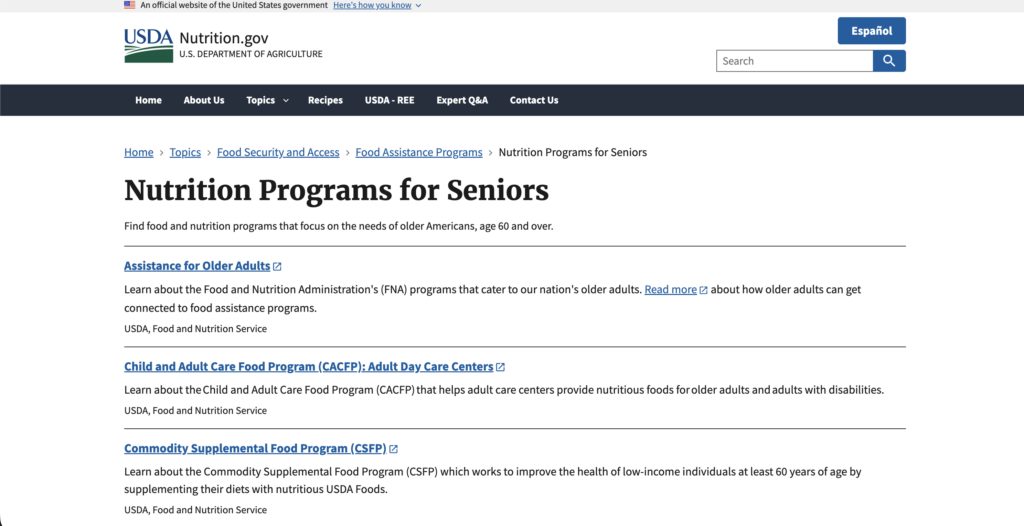
The Older Americans Act helps fund nutrition services for older adults through local aging networks. These programs include meals served at community locations and home-delivered meals for people who meet the applicable criteria.
The general federal age threshold is 60. Programs also consider factors such as need, mobility, and access to food when deciding whom to serve first.
Home-delivered meals provide more than nutrition in some communities. Regular deliveries may also create opportunities for someone to check on an older adult’s well-being.
These services are not always limited to people with extremely low incomes. Local programs may request voluntary contributions, but they have rules about eligibility and how services are provided.
Area Agencies on Aging can explain which meal services operate locally. The federal Eldercare Locator also connects older adults with community resources through its telephone service at 800-677-1116.
13. Medicare Preventive Benefits Can Cover Services You Might Otherwise Pay For

Older adults sometimes pay for health services without realizing that Medicare already covers a preventive benefit. In other cases, they skip appointments because they expect another medical bill.
Medicare Part B covers a range of preventive services, including certain screenings, vaccinations, and wellness visits. Coverage depends on the service, medical circumstances, and Medicare’s rules.
One often misunderstood benefit is the yearly Medicare Wellness visit. It helps develop or update a personal prevention plan rather than providing a complete physical examination.
For eligible beneficiaries, Medicare covers this visit once every 12 months. There is generally no cost for the covered visit when the provider accepts Medicare assignment, although additional services performed during the same appointment can lead to charges.
The visit may cover medication review, health risks, preventive screening needs, and other subjects related to staying healthy. Certain screening services also have their own Medicare coverage rules.
Older adults can ask their medical provider which preventive services they are due to receive. Before scheduling, they should confirm whether any additional tests or procedures could lead to separate charges.
14. Property Tax Relief May Save Older Homeowners Money Every Year

Owning a home does not mean retirement housing is inexpensive. Property taxes, insurance, maintenance, and repairs can consume a significant share of a fixed income.
Some states and local governments offer property tax exemptions, credits, freezes, or deferral programs for qualifying older homeowners. These programs are not uniform across the country.
Eligibility may depend on age, income, ownership, residency, disability, or the property’s assessed value. Some programs reduce an existing tax bill, while others provide relief through a credit or delayed payment arrangement.
New York, for example, has senior citizen property tax exemptions for qualifying homeowners age 65 and older. The state also operates Enhanced STAR benefits for certain eligible older homeowners, with separate income and other rules.
A homeowner should not assume the same benefits exist everywhere. County, city, and state rules can differ, sometimes even between nearby communities.
County assessors, property tax offices, and state revenue departments can explain local senior relief programs. Homeowners should also ask about application deadlines because certain exemptions must be renewed or claimed within a specific period.
15. VA Aid and Attendance Can Increase Pension Support for Eligible Veterans

Some older veterans need help with daily activities but do not know that additional pension support may be available. Surviving spouses may also overlook benefits connected to a qualifying veteran’s service.
VA Aid and Attendance and Housebound benefits can increase the pension amount for eligible veterans or survivors who meet additional requirements. These are not automatic payments available to every veteran.
Aid and Attendance may apply when someone needs help with daily tasks such as bathing, dressing, or eating. Certain nursing home situations and serious vision limitations may also meet the program’s medical requirements.
Housebound benefits apply under different conditions, including when a person is substantially confined to their home because of a permanent disability. A claimant cannot receive both allowances at the same time.
Income and other pension eligibility rules still matter. However, the higher pension limits associated with these benefits may allow some people to qualify even if they would not qualify for the basic pension amount.
Veterans and surviving spouses can request an eligibility review through the Department of Veterans Affairs. An accredited Veterans Service Officer can also explain the application process and help determine whether Aid and Attendance or Housebound benefits may apply.
What You Should Gather Before Applying for Benefits
Different programs require different paperwork, but having basic financial records in one place can make the process easier. Missing documents can delay an application or prevent an agency from calculating the correct benefit.
This quick checklist covers information commonly requested during benefit reviews.
| Document | Why You May Need It |
|---|---|
| Government-issued identification | Confirm age and identity |
| Social Security benefit statement | Show retirement income |
| Bank and asset information | Verify resources when required |
| Medicare card | Check medical coverage |
| Recent utility bills | Support energy assistance applications |
| Rent statement or property tax bill | Verify housing expenses |
| Medical expense records | Document eligible expenses |
| Military discharge records | Support certain veterans benefit claims |
Not every program asks for every document. The agency handling your application should explain which records are required and whether copies are acceptable.
Keep important financial documents in a secure place. Avoid sending Social Security numbers, banking details, or identification documents to unfamiliar websites claiming to distribute government grants.