
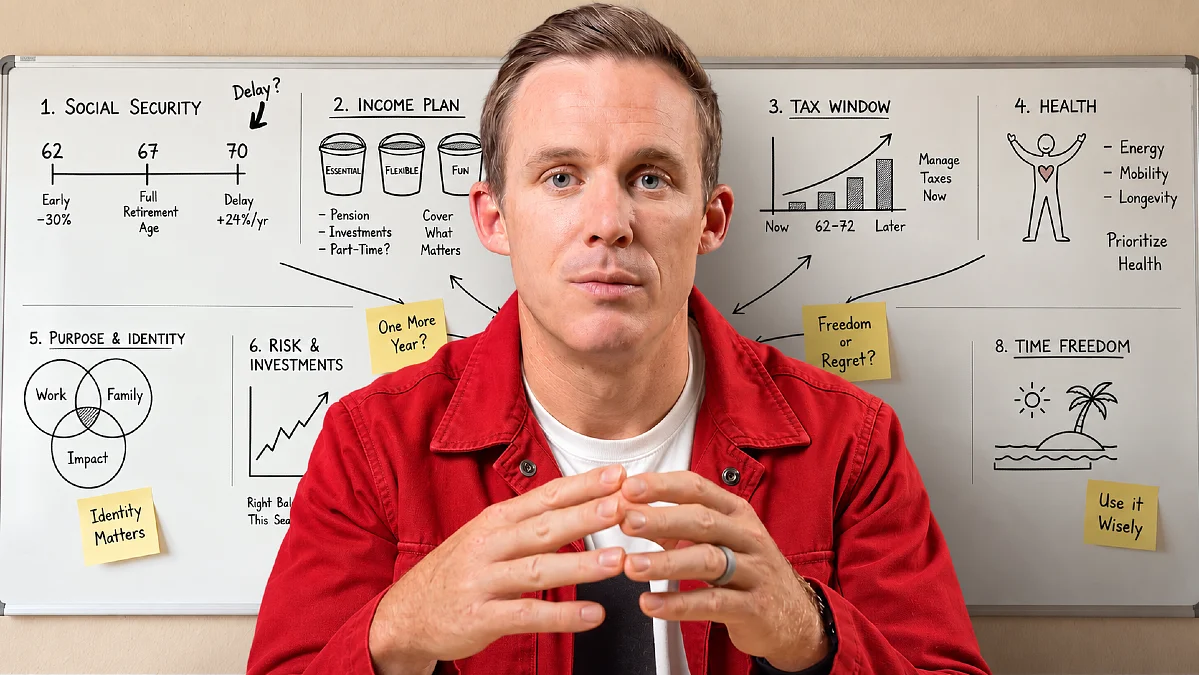
Turning 62 brings a strange financial question. You may have spent nearly 40 years saving for retirement, yet deciding when to stop working can feel harder than building the savings themselves.
One more year of income sounds sensible, but what if that extra year costs you something money cannot replace?
Many people focus on Social Security checks, investment returns, and reaching a certain savings balance. Those things matter, but retirement advisors also encourage people to think about their health, freedom, relationships, and how they want to spend their remaining years.
1. Stop Assuming That Working Longer Is Always the Smarter Choice

At 62, many financial signals encourage you to keep working. Your salary may be higher than ever, your retirement accounts may still be growing, and delaying Social Security can increase your future monthly benefit. Another few years of work can seem like the safest decision.
But some retirement advisors warn about what could be called the momentum trap. You keep working because that is what you have always done, even when your financial situation may already support retirement. The decision becomes automatic rather than intentional.
Working longer can be an excellent choice when you need more savings, enjoy your career, or want better financial protection. The problem begins when you continue working without checking whether those extra years will meaningfully improve your life.
Ask yourself a simple question: If I already had enough money to support my retirement, would I still choose to work? Your answer may reveal whether you are working for financial security, personal satisfaction, or simply because stopping feels uncomfortable.
2. Decide What Enough Money Actually Means for Your Retirement

One of the most useful things a retirement advisor can help you determine is your personal retirement number. This is not the largest investment balance you could possibly build. It is the amount needed to support the life you want while maintaining reasonable protection against future risks.
Someone with $800,000 in savings, a paid off home, and a modest lifestyle may have different needs than someone with $2 million and substantial monthly expenses. Neither balance automatically proves that the person is ready or unprepared.
The important question is how your dependable income, savings, expenses, and future needs fit together. Your plan should also account for inflation, taxes, health costs, and the possibility of living well into your 90s.
| Retirement Question | Why It Matters |
|---|---|
| How much do you spend monthly? | Establishes your basic income needs |
| How much guaranteed income will you receive? | Shows how much spending is already covered |
| What debts will remain? | Identifies continuing financial pressure |
| How much do you need for emergencies? | Protects against unexpected expenses |
| What activities matter most? | Gives your savings a clear purpose |
| How long must your money last? | Helps determine a sustainable spending plan |
A retirement number becomes more useful when it connects to real spending. Instead of aiming endlessly for another $100,000, work out what that additional money would actually change.
If it would protect your spouse, cover needed care, or make your retirement safer, continuing to save may be worthwhile. If it would simply increase an already comfortable balance, you may want to consider what you are giving up to earn it.
3. Build a Retirement Paycheck Before Leaving Your Job

During your working years, income arrives through a familiar system. Your employer deposits your paycheck, bills get paid, and whatever remains can go toward savings or personal spending. Retirement changes that arrangement.
You may have money spread across a 401(k), traditional IRA, Roth IRA, brokerage account, savings account, or pension. Instead of relying on one paycheck, you must decide how these different sources will support your monthly needs.
This is why advisors emphasize creating a retirement income plan before leaving work. Having a large investment balance is useful, but knowing how to turn those investments into dependable spending money is equally important.
Consider a hypothetical retired couple who want to spend $10,000 each month. Their combined Social Security benefits eventually provide $5,000, leaving another $5,000 to come from retirement savings.
| Monthly Income Plan | Amount |
|---|---|
| Desired monthly spending | $10,000 |
| Combined Social Security income | $5,000 |
| Needed from savings each month | $5,000 |
| Annual withdrawals from savings | $60,000 |
These amounts are examples rather than typical retirement costs. Taxes, investment performance, and the timing of Social Security would also affect the couple’s actual withdrawal needs.
The next decision is where that $60,000 should come from. Traditional retirement accounts, Roth accounts, and taxable investments have different tax rules, so the order of withdrawals can change the final amount available to spend.
A good income plan addresses these choices before a market downturn or unexpected expense forces a quick decision. It should also be reviewed as spending needs and account balances change.
4. Do Not Automatically Claim Social Security at 62 or Wait Until 70

Social Security is one of the biggest decisions people face when turning 62. You can generally start retirement benefits at that age, but claiming early reduces your monthly payment compared with waiting until full retirement age.
For people turning 62 in 2026, full retirement age is 67. Under current rules, claiming at 62 reduces a worker’s benefit by 30%, while waiting until 70 increases it to 124% of the full retirement age amount.
Here is a simple example using a $2,000 monthly benefit at age 67.
| Claiming Age | Monthly Benefit |
|---|---|
| 62 | $1,400 |
| 67 | $2,000 |
| 70 | $2,480 |
These are simplified amounts before future cost of living adjustments. Actual payments depend on your earnings history, claiming month, and personal circumstances.
The larger payment at 70 can be valuable, especially for someone expecting a long retirement. Delaying may also improve the survivor benefit available to a spouse when the higher earner dies.
However, waiting is not automatically the best choice. If you retire at 62 and delay Social Security until 70, your savings may need to cover eight years of expenses before benefits begin.
That can place considerable pressure on investments, particularly during a weak market. Advisors therefore compare lifetime benefits with the amount you must withdraw while waiting.
The goal is not simply to receive the biggest Social Security check. It is to choose a claiming strategy that supports your entire retirement plan.
5. Protect Your Savings Against a Market Decline Early in Retirement
A retirement portfolio can look strong when markets are rising. The real test comes when investment prices fall while you are withdrawing money to cover living expenses.
Consider a person retiring at 62 with a $2 million investment portfolio. Suppose they need $120,000 each year after taxes and, for illustration, must withdraw $150,000 before taxes to cover that spending.
That creates an initial withdrawal rate of 7.5%. Now consider what happens if the portfolio drops by 25%, reducing its value to $1.5 million.
| Portfolio Situation | Annual Withdrawal | Withdrawal Rate |
|---|---|---|
| Starting portfolio of $2 million | $150,000 | 7.5% |
| After portfolio falls to $1.5 million | $150,000 | 10% |
The annual withdrawal has not changed, but it now consumes a much larger share of the remaining savings. Selling investments after a major decline can also reduce the money available to benefit from a later market recovery.
Advisors call this sequence of returns risk. Poor market performance early in retirement can be especially damaging because withdrawals continue while investments are recovering.
One way to prepare is to keep an appropriate amount of near term spending money in cash or other relatively stable investments. A flexible spending plan can also help reduce withdrawals during difficult market years.
Social Security timing matters here, too. Claiming earlier may reduce the need to sell investments, while delaying provides a larger benefit later. Neither approach is always superior, so both should be tested against market declines.
6. Take Advantage of the Tax Planning Window After You Stop Working

Many people spend their careers thinking about taxes mainly through their paychecks. Once they retire, they may have more control over when they recognize certain types of taxable income.
Your salary may disappear, but your savings remain spread across accounts with different tax treatments. This creates opportunities to plan withdrawals more carefully instead of taking money from whichever account is easiest to access.
For example, traditional IRA withdrawals are generally taxable, while qualified Roth IRA withdrawals are tax free. Taxable brokerage accounts may generate capital gains, which can receive different tax treatment depending on your situation.
A particularly important period can occur between leaving work and beginning Social Security or required minimum distributions. During those years, some retirees temporarily fall into lower income tax brackets.
Possible strategies include converting part of a traditional IRA to a Roth IRA, realizing selected capital gains, or balancing withdrawals across several accounts. Each strategy has advantages and possible costs.
| Tax Planning Strategy | Potential Benefit | What to Watch |
|---|---|---|
| Roth conversion | May reduce future taxable IRA balances | Creates taxable income in the conversion year |
| Planned IRA withdrawals | Can spread taxable income across years | May increase current taxes |
| Capital gains planning | May use favorable capital gains rates | Depends on total taxable income |
| Coordinating Social Security | May help manage lifetime taxes | Claiming age affects monthly benefits |
| Managing investment income | Can improve control over annual taxes | May affect health insurance costs |
For someone turning 62 in 2026, current rules generally place the required minimum distribution starting age at 75. That can leave several years to consider tax planning before mandatory withdrawals begin.
However, these decisions cannot be made by looking only at federal income taxes. Larger withdrawals or Roth conversions may affect Marketplace health insurance assistance before Medicare and Medicare premiums later.
The advice is simple: review your taxes before making large withdrawals or conversions. A decision that saves taxes in one year may create additional costs elsewhere.
7. Have a Health Insurance Plan for the Years Before Medicare

Turning 62 does not make most Americans eligible for Medicare. Standard Medicare eligibility generally begins at 65, which can leave a three year gap for someone retiring at 62.
This is one reason people sometimes continue working even when their retirement savings appear sufficient. Employer health insurance can be valuable, particularly when a spouse or dependent also relies on the policy.
Before retiring, compare the full costs of available coverage. Options may include a spouse’s employer plan, COBRA continuation coverage, retiree health benefits, or a Health Insurance Marketplace plan.
Do not compare premiums alone. Deductibles, prescription coverage, specialist visits, provider networks, and annual out of pocket costs can change which plan offers the best overall value.
Marketplace financial assistance may be available depending on household income and other eligibility rules. Because retirement withdrawals can affect that income, health insurance planning should be coordinated with your investment and tax decisions.
Once you approach 65, review Medicare enrollment deadlines as well. Your first enrollment period generally spans seven months around your 65th birthday, although different rules may apply when you have qualifying employer coverage.
8. Review Insurance Policies Before Continuing to Pay for Them

Insurance needs often change as people approach retirement. Coverage that made excellent sense at 35 may no longer provide the same value at 62.
Consider someone who purchased a large life insurance policy while raising children and paying a mortgage. That coverage may have protected the household against losing its main source of income.
By 62, the children may be financially independent, the mortgage may be paid off, and retirement savings may have grown substantially. The original reason for buying the policy may therefore have changed.
That does not mean everyone should cancel life insurance when retiring. A surviving spouse may still need income protection, and some policies serve estate, business, or other financial goals.
Instead, advisors encourage people to review what each policy protects and whether the cost remains justified. This also applies to disability coverage, which may become less useful once employment income ends.
On the other side, some people discover that their home, auto, or personal liability protection has not kept pace with their assets. An umbrella insurance policy may deserve consideration if a large claim could threaten retirement savings.
Review coverage amounts, exclusions, deductibles, premiums, and available alternatives before making changes. Never cancel an existing policy until you know whether replacement coverage is needed and available.
9. Prepare for Long Term Care Without Putting Your Spouse at Risk
Long term care is one of the retirement expenses that can be hardest to predict. You may never need extended assistance, but a serious illness or lasting disability could create substantial costs.
Some older adults eventually need help with bathing, dressing, meals, transportation, or managing daily activities. That assistance may take place at home, in an assisted living community, or in a nursing facility.
Medicare generally does not cover ongoing custodial care, although it may cover certain medically necessary skilled services. This means families may have to pay for much of the assistance required over an extended period.
For married couples, the financial effect can extend beyond the person receiving care. Savings used to pay for several years of assistance may leave the surviving spouse with fewer resources for their own retirement.
A long term care plan should therefore consider both partners. That could involve insurance, dedicated savings, available family support, housing decisions, or a combination of approaches.
Not everyone needs a separate long term care insurance policy. Premiums, benefits, exclusions, and financial resources vary, so the right decision depends on the household.
The important step is to test what would happen if one spouse required expensive assistance for several years. Waiting until care becomes necessary can leave fewer choices.
10. Give Your Retirement Portfolio a Purpose Beyond Getting Bigger

Watching investment balances grow can become a habit. During your working years, reaching another savings goal usually feels like progress, so it is natural to keep pursuing larger numbers.
But retirement changes the purpose of that money. Savings are no longer only something to accumulate. They are also a resource for supporting your life, your family, and the goals you care about.
A portfolio might pay for ordinary living expenses, travel, hobbies, charitable giving, or financial help for children and grandchildren. It might also provide peace of mind by protecting against future emergencies.
The key is deciding what your money is meant to accomplish. Otherwise, you may continue delaying meaningful activities even after your retirement plan can comfortably support them.
Consider two people who have sufficient savings for their needs. One continues working because the account balance has become a measure of success, while the other chooses to retire and spend more time with family.
Neither choice is automatically correct. But the first person should know what the additional earnings are intended to provide, rather than assuming a larger balance always creates a better retirement.
Your investment portfolio is a tool for supporting your life. It should not become the only goal of your life.
11. Remember That Your Identity Is Bigger Than Your Career

Leaving work can be difficult for reasons that have little to do with money. After decades of employment, your career may provide much of your daily structure, confidence, social contact, and sense of achievement.
You may be known as the manager, teacher, business owner, engineer, or person everyone calls when something needs fixing. Retirement can feel uncomfortable when those familiar roles suddenly become less central.
The same challenge applies to people who have always been careful savers. Spending money after decades of saving can feel wrong, even when the financial plan shows that the spending is affordable.
This is why retirement preparation should include emotional and practical changes, not just investment calculations. Begin creating a life outside work while you still have a job.
Maintain friendships, explore hobbies, volunteer, learn something new, or take on a project that gives your week meaning. These activities can make retirement feel like the start of a different routine rather than the loss of your old one.
You do not have to replace your career with another demanding schedule. The goal is to have enough purpose, connection, and personal freedom that your days feel worthwhile.
12. Stop Saving Every Good Experience for Later
There is a difficult truth behind much of the advice people receive at 62. Your financial resources may continue growing for many years, but your physical abilities, family circumstances, and personal interests may change.
A trip that feels easy at 62 might be more difficult at 82. Spending a week with grandchildren may also look different when they are young compared with when they have careers and families of their own.
This does not mean that life becomes less enjoyable after a certain birthday. Many people remain active, curious, and deeply engaged well into their 80s and 90s.
The point is that some opportunities are easier to enjoy during particular stages of life. Delaying every experience until your savings reach another milestone can create regrets that money cannot solve later.
Financial planning should protect your later years, but it should also allow room for experiences you value today. That might mean spending more time with a spouse, visiting an old friend, taking a manageable trip, or simply working fewer hours.
The balance will be different for everyone. Someone with limited savings may need to keep working, while someone financially secure may have more freedom to reduce work or retire.
Either way, planning for the future should not require putting every meaningful part of the present on hold.
Five Questions Retirement Advisors Want You to Answer at 62
Before deciding whether to retire, continue working, or start Social Security, take time to answer these five questions.
| Question | What Your Answer Should Reveal |
|---|---|
| Can my savings support my expected retirement expenses? | Whether retirement is financially realistic |
| What happens if the stock market falls sharply? | How well your income plan handles investment losses |
| When should I claim Social Security? | How claiming age affects savings, income, and a spouse |
| Am I protected against major health and care expenses? | Whether important financial risks remain |
| What would I do with my time if I stopped working? | Whether retirement supports a meaningful daily life |
These answers will rarely be perfect. Expenses change, investment returns are uncertain, and personal priorities can shift as you grow older.
However, they can show where your plan is strong and where more preparation is needed. A qualified financial advisor or tax professional can help test major decisions using your actual income, assets, and household circumstances.