
Air travel after 60 can become unnecessarily stressful when boarding feels rushed, overhead bags are difficult to lift, or passengers don’t know what assistance they can request. Small mistakes before takeoff can lead to physical discomfort, missed accommodations, and hours of frustration.
What many older travelers don’t realize is that airlines already provide several services designed to make flying easier and safer. Some are protected by federal disability rules, while others depend on airline policy and availability.
These 10 boarding tips reveal what to ask, when to ask, and how to make the entire flight more comfortable.
1. Ask for Help With Overhead Bags Before You Struggle
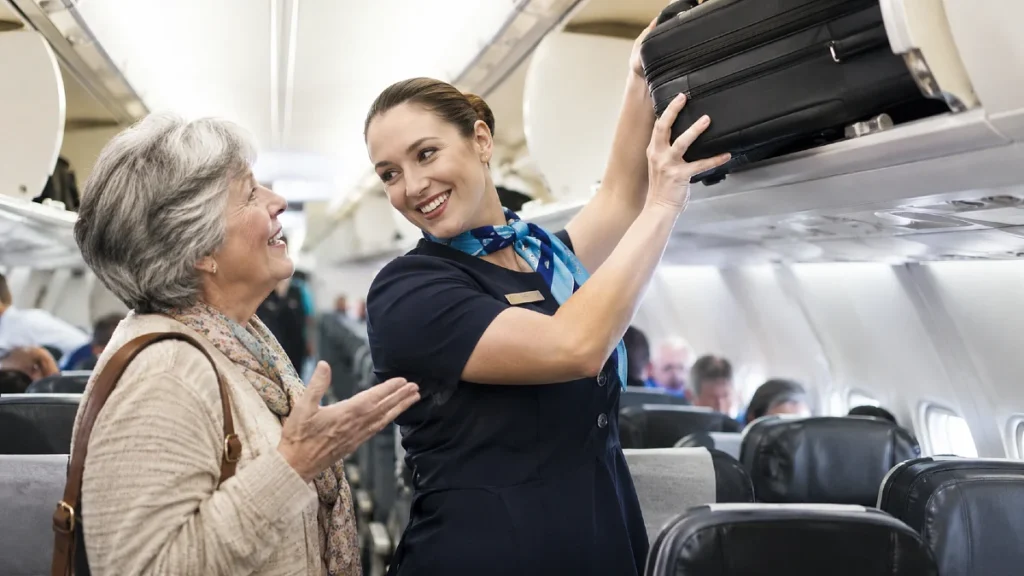
One of the most common boarding problems happens when travelers attempt to lift heavy carry-on luggage into overhead compartments. A bag that feels manageable on the ground can become difficult to control when raised above shoulder height in a crowded aisle.
For older adults with arthritis, shoulder problems, limited strength, or recent surgery, forcing a suitcase overhead can cause unnecessary pain. Flight attendants would rather address an assistance request than deal with an injury during boarding.
Under U.S. Department of Transportation rules, airlines must provide help stowing and retrieving carry-on items when a passenger with a disability identifies the need for assistance. However, this does not mean flight attendants must personally lift every passenger’s suitcase simply because someone requests it.
What to say: “I have a mobility limitation and need assistance stowing my carry-on bag. Could someone help me, please?”
A crew member may help directly or arrange assistance from another airline employee. The best time to ask is before reaching your row, rather than standing in the aisle while other passengers wait behind you.
There is also a simple way to reduce the problem before leaving home. Pack medications and other essentials in a small personal item, and keep the larger carry-on light enough to handle safely when possible.
The goal is not to prove that you can still lift a heavy suitcase. It is to avoid an unnecessary injury before your vacation has even begun.
2. Check for a Movable Aisle Armrest Before Sitting Down
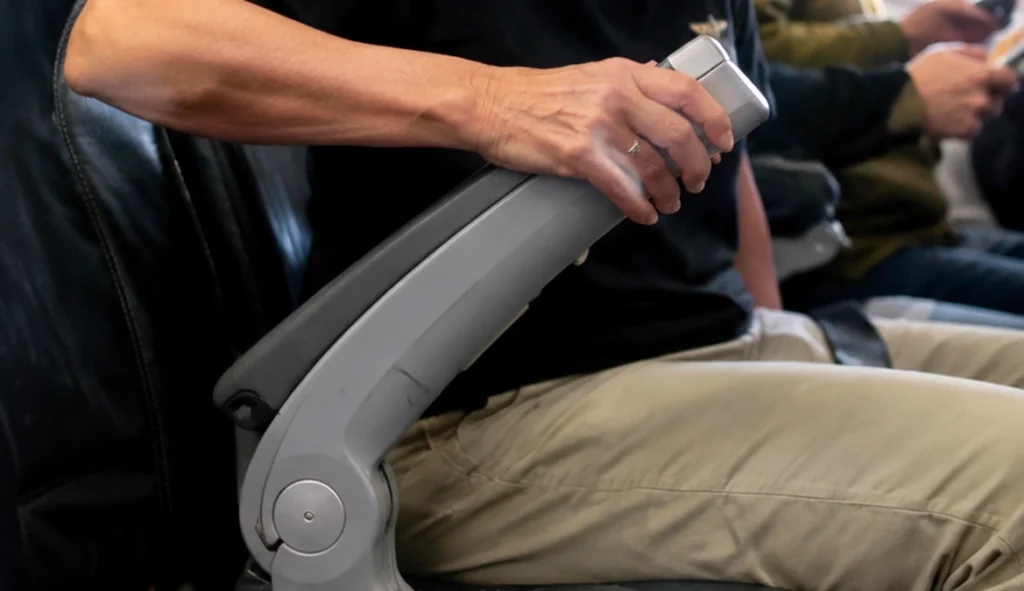
Many passengers have spent years flying without realizing that some aisle seats have armrests that can be raised. This small feature can make getting into and out of an airplane seat much easier.
On certain aircraft, a release button or lever sits beneath the aisle-side armrest, often near its rear connection. Releasing it allows the armrest to move upward, creating more space for passengers entering or leaving the seat.
This can be particularly helpful for travelers who have undergone hip surgery, have limited knee movement, or find turning into narrow seats uncomfortable.
However, not every aisle seat has a movable armrest. Aircraft configurations differ, and some armrests may have restrictions on their use.
The Department of Transportation requires airlines to identify the location of movable aisle armrests when passengers with disabilities request that information.
What to say: “Does my aisle seat have a movable armrest, and could you show me how to use it?”
If you use an aisle wheelchair and cannot transfer easily over a fixed armrest, federal rules provide specific seating protections. Contacting the airline before departure gives staff more opportunity to arrange an appropriate seat.
Remember that an armrest may need to return to its normal position for takeoff and landing. Follow the flight attendant’s instructions rather than assuming it can remain raised throughout the flight.
For some older passengers, this small adjustment can make the difference between an awkward struggle and a comfortable transfer into their seat.
3. Request Preboarding When You Need Additional Assistance
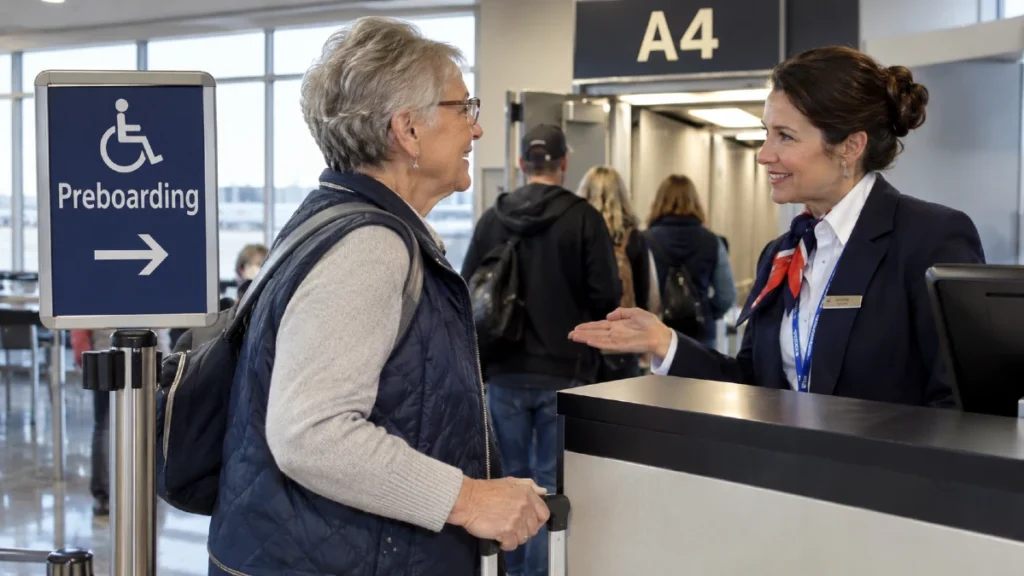
Many older passengers assume that preboarding is only available to people using wheelchairs. Others believe they must provide medical paperwork or explain their full medical history before receiving additional boarding time.
Neither assumption is generally correct.
Under the Air Carrier Access Act’s implementing rules, passengers with disabilities who identify themselves as needing additional time or assistance to board must be offered preboarding. A disability can be temporary or permanent, and it does not need to be immediately visible.
This can include someone who needs extra time because of a mobility-related limitation. Age alone, however, does not automatically qualify a passenger for disability preboarding.
What to say: “I have a mobility limitation and need additional time to board safely. May I use preboarding?”
Speak with the gate agent before general boarding starts. In most ordinary situations, passengers do not need medical documentation to request this accommodation.
Preboarding allows eligible travelers to enter before the general rush, locate their seats, and get settled without feeling pressured by the line behind them. Airlines with approved alternative boarding arrangements may handle the sequence differently.
Travelers accompanied by a person who provides essential assistance should ask how the airline will accommodate that companion. Do not assume every travel partner automatically receives the same boarding priority.
Who May Qualify for Additional Boarding Help?
| Situation | Preboarding Guidance | Best Action |
|---|---|---|
| Mobility-related disability | Eligible when extra time or assistance is needed | Inform the gate agent |
| Temporary physical disability | May qualify | Explain the assistance needed |
| Wheelchair or aisle-chair user | Boarding assistance is available | Arrange support with the airline |
| Age 65+ without a disability-related need | No automatic federal entitlement | Check the airline’s boarding policy |
| Traveling with an assisting companion | Accommodations depend on the assistance needed | Request arrangements together |
The most useful distinction is between needing assistance because of a disability and simply preferring to board earlier. Knowing the difference helps travelers make appropriate requests without misunderstanding their rights.
Preboarding can also reduce physical stress for travelers who walk slowly, need assistance reaching their seats, or have difficulty standing in crowded boarding lines.
4. Find Out Which Lavatory Is Best Before Takeoff
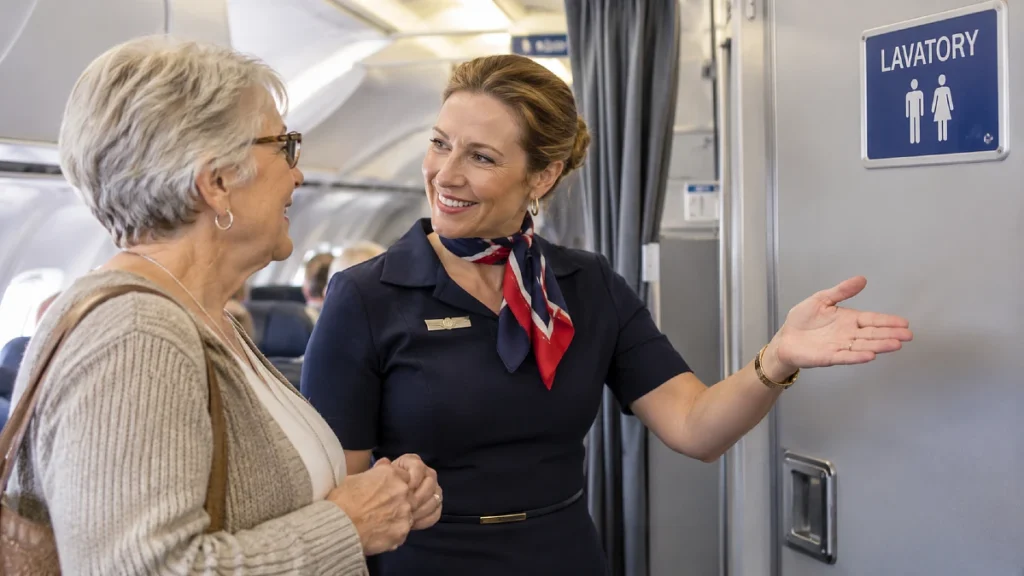
Most passengers automatically use the airplane restroom closest to their assigned seat. However, the nearest lavatory is not necessarily the easiest or most practical option, especially for travelers with limited mobility.
Aircraft have different restroom layouts, and some larger planes include accessible lavatories with additional space or support features. On smaller aircraft, facilities may be much more restrictive.
There is also a common misunderstanding about front-cabin restrooms. Some travelers assume they can always use a lavatory near business or first class, but access may depend on the airline’s cabin rules and crew instructions.
Rather than guessing, ask a flight attendant which restroom you should use. They can explain the aircraft layout and identify any accessible facilities.
What to say: “Which lavatory would be easiest for me to reach, and is there one with more room?”
Timing also matters. The aisle may become crowded shortly after the seat belt sign turns off, while beverage carts can temporarily block access later in the flight.
There is no guaranteed quiet period for airplane restrooms, so avoid relying on a specific schedule. Ask the crew for guidance and use the lavatory when it is safe and reasonably convenient.
For passengers who need mobility assistance, airlines must provide certain types of support, including help reaching the restroom. However, flight attendants generally are not required to provide personal care inside the lavatory.
Taking a moment to discuss restroom access before departure can prevent considerable discomfort later.
5. Keep Essential Medications Within Easy Reach
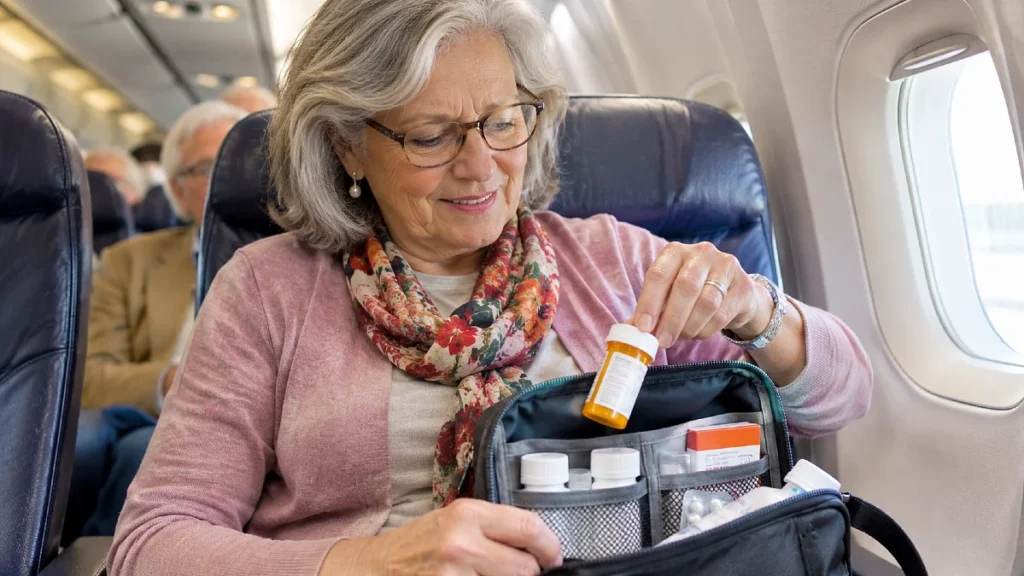
Imagine needing prescription medication halfway through a flight, only to realize it is inside a suitcase stored several rows away. Retrieving it may be difficult when passengers are sleeping, turbulence develops, or the seat belt sign remains illuminated.
This situation is especially concerning for travelers who depend on time-sensitive medication or emergency treatments. A little organization before boarding can prevent unnecessary delays.
The safest general approach is to carry essential medications in your personal item rather than checked baggage. When possible, keep that bag under the seat in front of you so the medication remains accessible.
Never place essential medication in checked luggage if you may need it during the flight. Checked bags can be delayed, misplaced, or inaccessible during an unexpected travel disruption.
The Transportation Security Administration permits medically necessary liquids in quantities greater than the standard 3.4-ounce carry-on limit, subject to screening requirements.
A small medication pouch can help keep everything organized. Include prescription medications, emergency treatments, and any instructions you may need while traveling.
Where to Pack Important Travel Essentials
| Item | Recommended Location | Why It Matters |
|---|---|---|
| Daily prescription medication | Personal item | Accessible during the flight |
| Emergency medication | Easily reached pouch | Reduces delays when needed |
| Medication list | Personal item | Useful during medical emergencies |
| Larger clothing items | Carry-on or checked bag | Not usually needed immediately |
| Important medical devices | Cabin, following airline rules | Keeps necessary equipment available |
If your seat has no under-seat storage, such as certain bulkhead seats, ask the crew where essential items can be safely stored. All belongings must meet the aircraft’s takeoff, landing, and cabin safety requirements.
Some travelers also find it useful to keep a written medication schedule, particularly when crossing time zones. A pharmacist or prescribing clinician can help determine the correct timing when a long flight disrupts the usual routine.
Before takeoff, make sure you know exactly where your medications are located. That simple habit is more useful than discovering their location during an emergency.
6. Ask About Better Seating Before the Cabin Is Fully Settled
Getting assigned an uncomfortable airplane seat can make a long flight feel considerably longer. Narrow legroom, limited aisle access, or a difficult transfer into the seat may create problems for passengers with certain physical limitations.
Many travelers assume their seat assignment cannot change once boarding begins. However, airlines may sometimes accommodate a seating request when an appropriate alternative is available.
The important distinction is between a general comfort preference and a disability-related seating requirement.
U.S. airline accessibility rules provide certain seating accommodations for eligible passengers. For example, passengers with a fused or immobilized leg may qualify for a seat offering greater legroom, while some passengers need seats with movable aisle armrests.
These accommodations are subject to applicable rules and aircraft configurations. They do not create a general right to a free premium-cabin upgrade.
What to say: “My current seat is difficult for me to access because of a mobility limitation. Is there another seat that would better accommodate my needs?”
Ask the airline before your flight whenever possible. If a problem remains during boarding, speak with the gate agent or flight attendant while seating arrangements can still be reviewed.
A seat change might be possible after boarding finishes, but it is never guaranteed. Crew members must consider safety requirements, passenger assignments, aircraft balance, and airline policies.
Do not move into an empty seat without permission. An apparently unused seat may be unavailable for operational reasons or assigned to a passenger who has not yet boarded.
The smartest approach is to identify your seating needs when booking, confirm them at check-in, and follow up at the gate.
7. Tell the Crew About Assistance Needs That Matter During the Flight
Flight attendants are trained to respond to onboard emergencies, but they cannot automatically know every passenger’s medical or mobility needs. An outwardly healthy traveler may have a condition that affects how they move, communicate, or manage an emergency.
Passengers sometimes avoid mentioning their needs because they value privacy or do not want unwanted attention. However, sharing relevant information voluntarily can help the crew provide appropriate assistance.
That does not mean giving a flight attendant your complete medical history. Most travelers do not need to disclose routine diagnoses or list every prescription they take.
Instead, focus on a practical need that could affect the flight.
What to say: “I have a medical condition that may require assistance during the flight. Could I explain what help I might need?”
Someone who requires an aisle chair, has difficulty reaching the restroom, or needs specific communication assistance should tell the airline before traveling. Airlines can arrange some accommodations in advance, although certain specialized services require additional notice.
It is also important to understand the limits of cabin crew responsibilities. Flight attendants have emergency training, but airlines generally are not required to provide personal medical services or administer routine medications.
What to Request for Different Travel Needs
| Travel Concern | Useful Request | Important Limitation |
|---|---|---|
| Difficulty transferring into a seat | Movable aisle armrest | Not available at every seat |
| Limited leg movement | Appropriate seating accommodation | Depends on the qualifying need |
| Trouble reaching the restroom | Mobility assistance | Crew generally cannot provide care inside |
| Hearing or vision impairment | Accessible safety information | Explain the communication method needed |
| Medical equipment requirement | Advance accessibility arrangements | Equipment and airline rules vary |
Airlines are not necessarily required to pass every medical detail from a reservation directly to cabin crew. Travelers should confirm essential assistance arrangements instead of assuming the crew has received their medical information.
If a condition requires special onboard equipment or another person’s continuous help, contact the airline well before departure. Some situations also warrant discussing fitness to fly with a medical professional.
A short, practical conversation can be more helpful than arriving onboard and expecting the crew to anticipate everything.
8. Plan Food and Water Around Your Medication Schedule

One overlooked problem during air travel is assuming that food and water will be available exactly when needed. Passengers who take medications with meals may discover that the first beverage service comes much later than expected.
Airline service schedules vary with flight length, turbulence, aircraft staffing, and operating conditions. Some short domestic flights may offer only limited refreshments, while others may not provide a meal at all.
This means older travelers should not depend on the beverage cart to maintain a medically required eating or medication schedule.
Before boarding, review the instructions for any medication you may need during the flight. If it must be taken with food, carry a suitable snack that meets airline and destination rules.
Buying water after airport security can also be useful, although travelers should respect any fluid restrictions recommended by their clinicians.
What to say: “I need water to take medication during the flight. Would it be possible to get some when cabin service is safe?”
Crew members may be able to accommodate a request, but immediate service is not guaranteed. Turbulence and other safety responsibilities can prevent them from moving through the cabin.
Some airlines also offer special meals for passengers with dietary requirements. These usually need to be requested before departure, and the available choices, deadlines, and charges depend on the airline.
Do not assume a special meal will be served first or that every flight offers low-sodium, diabetic-friendly, or other medical-diet options. Verify the menu before relying on it.
For passengers managing diabetes or other conditions that require careful meal timing, advance planning is particularly important. Food, medication, and supplies should be organized according to personal medical instructions.
A small snack and an accessible bottle of water can make a bigger difference than waiting for the cart to arrive.
9. Understand the Exit-Row Rules Before Choosing Extra Legroom
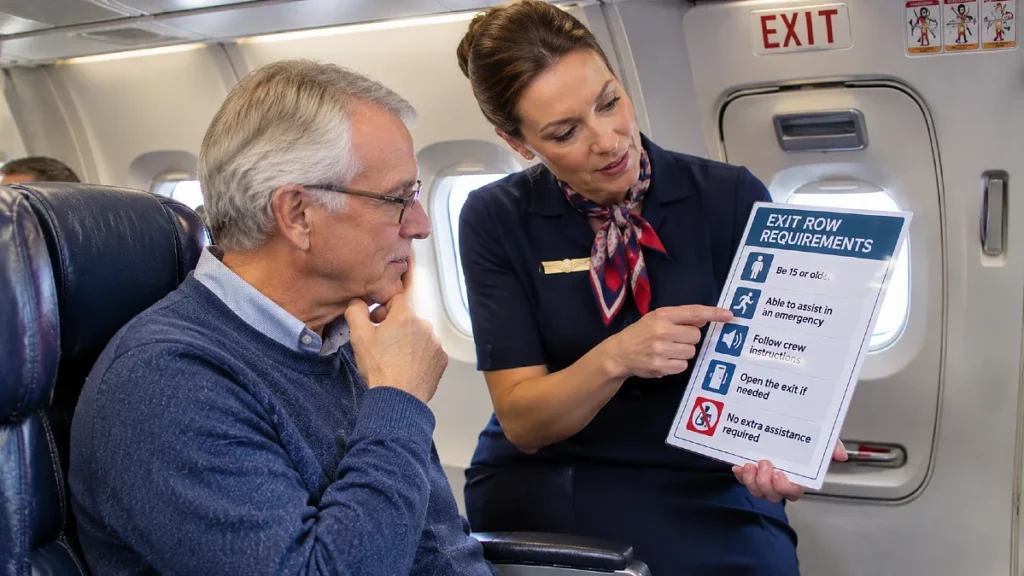
Emergency exit rows often attract passengers because they may offer additional legroom. However, these seats come with responsibilities that many travelers do not fully consider when booking.
Under FAA regulations, passengers seated in designated exit seats must be capable of performing the emergency functions associated with those seats. These can include operating an exit, moving obstructions, understanding safety instructions, and assisting with evacuation.
The important factor is not a passenger’s age. A healthy 75-year-old may be capable of meeting the requirements, while a younger passenger with limited mobility may not.
Passengers must also be willing to perform the required duties. Anyone unable or unwilling to carry them out should request a different seat.
For travelers with shoulder limitations, severe mobility problems, or conditions that make emergency physical activity unsafe, an exit-row seat may be unsuitable.
What to say: “I would prefer extra legroom, but I don’t think an emergency exit row is appropriate for me. Are there other seating options?”
Some airlines offer extra-legroom seats outside emergency exit rows, although they may cost more. Depending on the circumstances, a passenger with a qualifying disability may also be entitled to a suitable seating accommodation.
Do not assume the row immediately behind an exit row provides the same legroom. Seat dimensions vary across aircraft, and that row may offer no additional space.
Another consideration is that some exit-row seats have limited recline or specific restrictions on storing personal belongings. These differences can affect comfort during a long flight.
Flight attendants must verify compliance with exit-seat safety rules. Passengers who cannot meet the applicable requirements must be reseated in accordance with those rules.
The best seat is not necessarily the one with the most legroom. It is the one that provides appropriate comfort without creating a safety problem.
10. Request an Individual Safety Briefing When You Need One
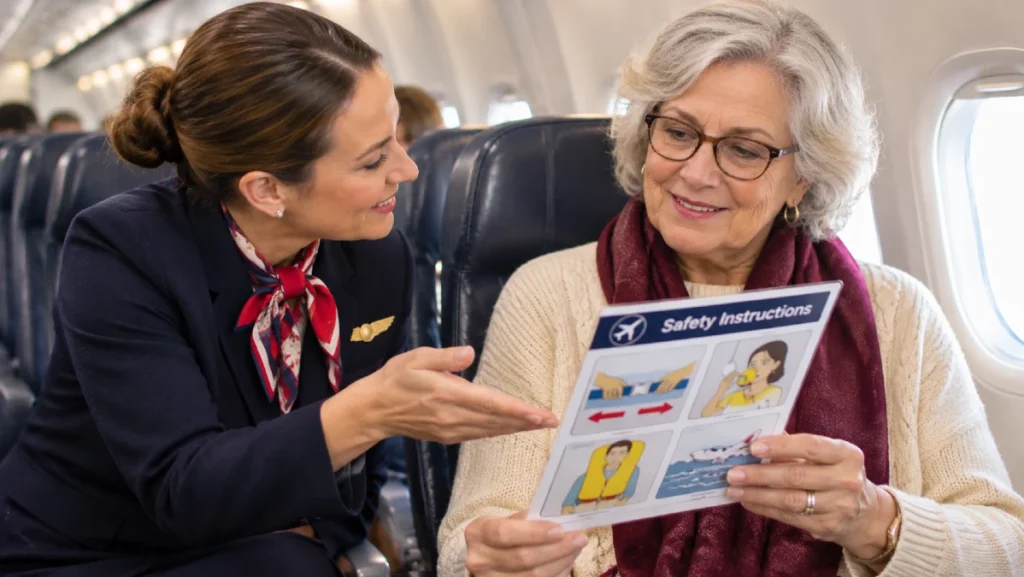
Most passengers watch the standard airline safety demonstration without asking questions. Yet a general presentation may not address the specific concerns of someone who needs assistance during an emergency.
This is where an individual safety briefing becomes valuable.
Federal aviation regulation 14 CFR 121.571 requires an individual briefing before takeoff for passengers who may need another person’s assistance to move quickly to an emergency exit. The briefing addresses appropriate evacuation routes and how assistance can be provided while reducing the risk of pain or injury.
This is not an automatic entitlement to a lengthy personal briefing for every traveler simply because they are over 60. The requirement is tied to specific emergency evacuation assistance needs.
However, any passenger can ask the crew to explain safety information they do not understand.
What to say: “I may need assistance evacuating in an emergency. Could we discuss the safest way for me to exit the aircraft?”
A flight attendant can explain the relevant safety procedures and determine how the required briefing should be handled. Ask before departure rather than waiting until the aircraft is moving.
For someone with limited mobility, this may include discussing suitable exits, the safest time to move, and how another person could provide assistance without causing additional injury.
Passengers with hearing or vision impairments can also request safety information in an accessible form. Airlines have separate obligations to provide effective communication to travelers with these disabilities.
Common Boarding Beliefs vs. Actual Rules
| Common Belief | What Travelers Should Know | Better Approach |
|---|---|---|
| Everyone over 60 can preboard | Age alone does not create disability preboarding rights | Request it when eligible |
| Flight attendants must lift all bags | Required assistance applies to passengers with qualifying disabilities | Explain the assistance needed |
| Every aisle armrest moves | Some armrests are fixed | Confirm the seat’s features |
| Exit rows are best for older travelers | Occupants must meet safety requirements | Choose a suitable non-exit seat if needed |
| Everyone has a right to a personal briefing | Specific evacuation-assistance needs trigger the individual briefing requirement | Explain your safety needs to the crew |
The most important lesson is that passengers should not assume every convenience is a federal right. Some services are legally required for eligible travelers, while others depend on airline procedures and available resources.